
Hydraulic Cylinders are at the heart of countless industrial, mobile, and manufacturing applications. While they may appear simple from the outside, their performance, reliability, and lifespan depend on a precise combination of internal components working in harmony.
Understanding the anatomy of a hydraulic cylinder isn’t just useful for engineers—it’s essential for anyone involved in specifying, maintaining, or designing hydraulic systems.
What Is a Hydraulic Cylinder?
A hydraulic cylinder converts hydraulic energy into linear mechanical force and motion. Pressurized hydraulic fluid acts on the internal components, creating controlled movement capable of handling extreme loads with precision.
The effectiveness of that movement depends entirely on the design and integration of each component.
Core Components of a Hydraulic Cylinder
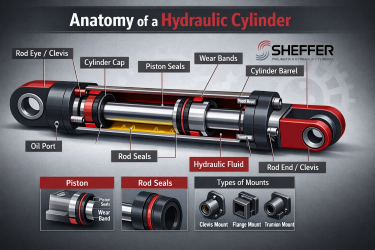
1. Cylinder Barrel
The barrel is the main body of the cylinder and houses the internal pressure. It must be precisely honed to reduce friction and ensure proper sealing. Any imperfection in the barrel can lead to premature seal wear or internal leakage.
2. Piston
The piston divides the interior of the barrel into two pressure chambers. As hydraulic fluid enters one side, it forces the piston to move. Piston design directly affects efficiency, load capacity, and smooth operation.
3. Piston Rod
Attached to the piston, the rod transfers force from the hydraulic system to the external load. Rod material, surface finish, and coating are critical factors in preventing corrosion, scoring, and fatigue failure—especially in demanding environments.
4. Cylinder Head
The head seals the cylinder on the rod end and guides the piston rod during operation. It also houses critical sealing components. Proper alignment here is essential to prevent side loading and uneven wear.
5. Cylinder Cap
Located at the opposite end of the head, the cap seals the barrel and contains the pressure on the non-rod side of the piston. Its strength and attachment method must match the application’s operating pressure and duty cycle.
6. Seals
Seals prevent hydraulic fluid from leaking internally or externally. This includes piston seals, rod seals, wear rings, and wipers. Seal selection depends on pressure, temperature, fluid type, speed, and environmental exposure.
7. Ports
Ports allow hydraulic fluid to enter and exit the cylinder. Their size, placement, and thread type impact flow efficiency and system responsiveness.
Why Component Design Matters
A hydraulic cylinder is only as reliable as its weakest component. When cylinders are underspecified or treated as off-the-shelf commodities, problems often emerge:
-
Inconsistent motion
-
Reduced load capacity
-
Excessive leakage
-
Premature seal or rod failure
Customizing cylinder design to the application—rather than forcing the application to fit a standard cylinder—can significantly improve performance and service life.
Designing for the Application, Not the Average
At The Sheffer Corp, we know that no two applications are truly identical. Load conditions, mounting style, stroke length, environmental exposure, and duty cycle all influence how a hydraulic cylinder should be designed.
That’s why understanding the anatomy of a cylinder is the first step toward building a solution that performs reliably in the real world—not just on paper.
Final Thought
Hydraulic cylinders may be common, but optimal performance is never accidental. It’s engineered—component by component.
The better you understand how each part functions, the better equipped you are to specify, design, and maintain cylinders that deliver long-term value.
If your application demands more than a standard solution, The Sheffer Corp specializes in custom hydraulic cylinders engineered to meet exact requirements.
👉 Visit our Customs page to see how we approach custom design from concept to completion.
Before starting your next project, make sure nothing is overlooked.
👉 Download The Ultimate Hydraulic Cylinder Design Checklist to guide smarter decisions and avoid costly rework.